

The Case for Daniel:
Why the Maccabean Date Does Not Settle the Question
By Eric Wilson
There is a standard move in critical biblical scholarship: when someone points to the Book of Daniel as evidence of genuine prophecy, the response is swift and confident. "Daniel was written during the Maccabean period — roughly 167 to 164 BCE. What looks like prediction is simply history written after the fact." Case closed.
I want to suggest that the case is not closed. Not because the Maccabean hypothesis is wrong — for the purposes of this argument I will grant it entirely — but because even under that dating, Daniel contains material that the Maccabean hypothesis does not adequately explain.
Granting the Premise
Let me be direct about what I am conceding. I am not going to argue that Daniel was written in the sixth century BCE. I am not going to insist that its detailed knowledge of Hellenistic history proves anything supernatural. A writer living in 164 BCE would know about Alexander the Great, the division of his empire, the long rivalry between the Ptolemaic and Seleucid kingdoms, and the persecution launched by Antiochus IV Epiphanes. Daniel 8 and much of Daniel 11 correspond strikingly with events that had already occurred by the time of a Maccabean author. I acknowledge that. The critical interpretation explains those chapters well.
The question I want to press is more specific: Does Daniel contain anything that a Maccabean author could not have known simply by recording recent history? I believe it does, and the evidence is concentrated in the ninth chapter.
The Seventy Weeks
Daniel 9 begins with Daniel reflecting on Jeremiah's prophecy of seventy years concerning Jerusalem. The angel Gabriel then transforms those seventy years into "seventy weeks" — a period of 490 years — to be allotted to Daniel's people and holy city. Six objectives frame this entire span: transgression is to be finished, sin brought to an end, iniquity atoned for, everlasting righteousness introduced, vision and prophecy sealed, and a most holy figure or place anointed.
Already this language exceeds what any persecution and its aftermath could accomplish. We are not simply being told that a pagan tyrant will stop harassing the Jews.
Verses 25 and 26 then supply a sequence. A decree goes forth to restore and rebuild Jerusalem. An anointed ruler appears. After sixty-nine weeks the anointed one is cut off. Afterward the people of a coming ruler destroy the city and the sanctuary.
The Problems with the Maccabean Reading
The Maccabean interpretation is not without merit. It commonly identifies the first anointed ruler with Cyrus and the anointed one who is cut off with the high priest Onias III, whose murder at Antioch is generally dated to around 171 BCE. The final week of years corresponds to Antiochus IV's suppression of Jewish worship and desecration of the Temple around 167 BCE, followed by its rededication in 164 BCE. These correspondences are genuine and should not be dismissed.
But the interpretation faces two serious difficulties.
The first is arithmetic. If the seven weeks represent the period from Jerusalem's destruction to the return under Cyrus — roughly 538 BCE — then sixty-two additional weeks of years (434 years) would bring us to approximately 104 BCE, not to the death of Onias III around 171 BCE. The actual period from 538 BCE to 171 BCE is only about 367 years. The deficit is roughly 67 years — far too large to attribute to uncertainty about a year or two.
Scholars have proposed solutions. George Athas, for instance, has suggested that the seven weeks and sixty-two weeks overlap rather than run consecutively. The proposal is ingenious. But notice what it requires: the apparent sequence of seven plus sixty-two plus one week can no longer be read as seventy sequential weeks of years. The periods must be reordered or overlapped to make the Maccabean chronology work. This is not the straightforward mathematical solution it is sometimes presented as being.
The second difficulty is more decisive. Antiochus IV undeniably desecrated the Temple. He plundered it, suppressed its sacrifices, and installed pagan worship within it. But he did not destroy it. The Temple that Judas Maccabeus rededicated in 164 BCE was the same Temple Antiochus had defiled.
Daniel 9:26, however, says explicitly: "The people of the prince who is to come will destroy the city and the sanctuary."
This is not a question of something destroyed being later rebuilt. The text says destroyed. Under Antiochus the sanctuary was desecrated. Under Rome, in 70 CE, the sanctuary was destroyed. These are not synonyms.
The Messianic Sequence
Consider the alternative.
Several Persian decrees could serve as the starting point for Daniel's timeline. Cyrus authorized Jewish restoration around 538 BCE. The decree of Artaxerxes to Ezra, generally dated to 458 or 457 BCE, is particularly significant because Ezra 7 goes beyond Temple ritual: Ezra is authorized to appoint magistrates and judges and to administer Jewish law across the region. There is a reasonable basis for reading this as a restoration of civil government as well as religious practice.
Sixty-nine weeks of years from 458/457 BCE — that is, 483 years — brings us into the late 20s CE: precisely the period in which Yeshua appears publicly, according to the Gospel accounts.
I want to be careful here. I am not claiming that Daniel predicted Yeshua's baptism to the exact year. The dating of Luke 3 admits of some debate, and Daniel does not specify that the anointed one must appear precisely at the end of the sixty-ninth week. There is also a point worth dwelling on: Daniel's prophecy was not designed primarily for our benefit. For us, knowing the precise year of the Messiah's arrival holds no particular advantage. But for Jews living in that era — with Temple records intact and accessible — precision mattered greatly. It helped establish that Yeshua was not a charlatan, but a genuine fulfillment of the prophetic tradition.
What interests me is not the precision but the sequence. Daniel describes an anointed figure who appears, is cut off, and is followed — afterward, not before — by the destruction of Jerusalem and its sanctuary. Now compare that with first-century history: Yeshua appears in the late 20s CE, is executed around 30 to 33 CE, and then, in 70 CE, the Roman army destroys Jerusalem and the Temple. The sequence in Daniel and the sequence in history align. And Daniel unquestionably existed before any of those first-century events occurred.
The Theological Weight of Verse 24
There is a further consideration. The six objectives listed in verse 24 — finishing transgression, making an end of sin, atoning for iniquity, bringing in everlasting righteousness, sealing vision and prophecy, and anointing a most holy person — cannot be reduced to what happened in 164 BCE. The death of Antiochus and the rededication of the Temple ended a terrible persecution. But did those events finish transgression, decisively deal with sin, atone for iniquity, and introduce everlasting righteousness? Historically, no.
A critical interpreter can respond that the Maccabean author expected these eschatological outcomes but was mistaken in that expectation. That is a coherent position. But notice what it concedes: we are no longer saying that Daniel 9 is simply history narrated after the fact. We are acknowledging that the text contains expectations reaching well beyond the events a Maccabean author already knew. Christianity claims that precisely these larger objectives begin to be accomplished through the Messiah's sacrificial death. That does not prove the Christian reading, but it means the theological content of verse 24 resists reduction to any merely historical episode.
Verse 27
I will not evade the difficult verse.
"He will confirm a covenant with many for one week, but in the middle of the week he will put an end to sacrifice and offering."
Who is "he"? The Maccabean interpretation naturally identifies the subject with Antiochus. Some Christian interpretations refer him to a future antagonist. Others understand the subject to shift back to the anointed figure of the preceding verses.
I will not claim the grammar settles the matter. But there is a coherent Messianic reading. The principal figure in verses 25 and 26 is the anointed one. The "prince who is to come" appears within a phrase describing whose people destroy Jerusalem — it is not impossible for the subject of verse 27 to return to the anointed figure.
More strikingly, the language itself invites attention. Daniel says this figure "will confirm a covenant with many." Compare Yeshua's words at the Last Supper: "This is my blood of the covenant, which is poured out for many for the forgiveness of sins" (Matthew 26:28). The correspondence of "covenant" and "many" is difficult to overlook.
Then Daniel says that in the middle of the week "sacrifice and offering are caused to cease." Did animal sacrifices physically stop when Yeshua died? No — they continued until 70 CE. I will not pretend otherwise. But according to Christian theology, their covenantal efficacy ended with Yeshua's sacrifice. The Letter to the Hebrews makes precisely this argument: the repeated animal offerings were shadows, while the Messiah offered the effective sacrifice once for all. His death can therefore coherently be understood as bringing sacrifice and offering to their appointed end in terms of divine function, even while priests continued performing the rituals for several more decades.
The remainder of verse 27 returns to the themes of abomination and desolation, culminating in decreed destruction — themes that find their obvious historical endpoint in Jerusalem's catastrophe of 70 CE. One notable tradition identifies the initial "abomination" with the advance of the Roman general Cestius Gallus against Jerusalem in 66 CE, an event that Yeshua's followers took as the signal to flee — consistent with the warning in Matthew 24. Whatever one makes of that specific identification, the larger framework of covenant, sacrificial cessation, abomination, and desolation remains coherent within a Messianic and Jerusalem-centered reading.
We must also bear in mind that Matthew 24:29, 30 speak of the calamity that would befall Jerusalem, a destruction brought about by God through Christ. It was the anointed one who ultimately caused the roman army to besiege and eventually destroy Jerusalem.
What a Maccabean Author Could Not Have Known
Let me now state the heart of the argument plainly.
A writer in 164 BCE could have known about Persia, Alexander, the Hellenistic successor kingdoms, and Antiochus IV. None of that proves prophecy.
But someone writing in 164 BCE could not have known that approximately two centuries later an anointed figure would appear in Judea, be put to death, and be followed by the destruction of Jerusalem and its Temple by a foreign power. That sequence of events is what Daniel 9:26 describes, and it is what first-century history delivered.
The Objection from Retrospective Interpretation
It could be argued that Christians simply read Daniel after the fact and applied it retrospectively to Yeshua. This possibility deserves serious consideration.
But it does not explain the existence of Daniel 9:26 itself. Christians did not insert into Daniel the sequence "anointed one cut off" followed by "city and sanctuary destroyed." We possess substantial evidence that Daniel existed long before 70 CE. Furthermore, Jews before and around the first century were already reading Daniel's seventy weeks chronologically and messianically. The Qumran text 11QMelchizedek — a first-century BCE document — incorporates Daniel's seventy-week framework into an eschatological expectation, explicitly connecting the anointed figure of Daniel 9:25 with a coming messianic deliverer. Christians did not invent a messianic reading of Daniel after 70 CE. They applied an existing framework to events they believed had fulfilled it.
Chapter 11 Does Not Apply to Antiochus
Philip Mauro developed this view most fully in The Seventy Weeks and the Great Tribulation (1923). Under this view, “the king” of verse 36 is Herod, the “king of the south” is Ptolemaic Egypt under Cleopatra VII, and the “king of the north” in verse 40 is Rome under Octavian (Augustus). Josephus supplies most of the detail.
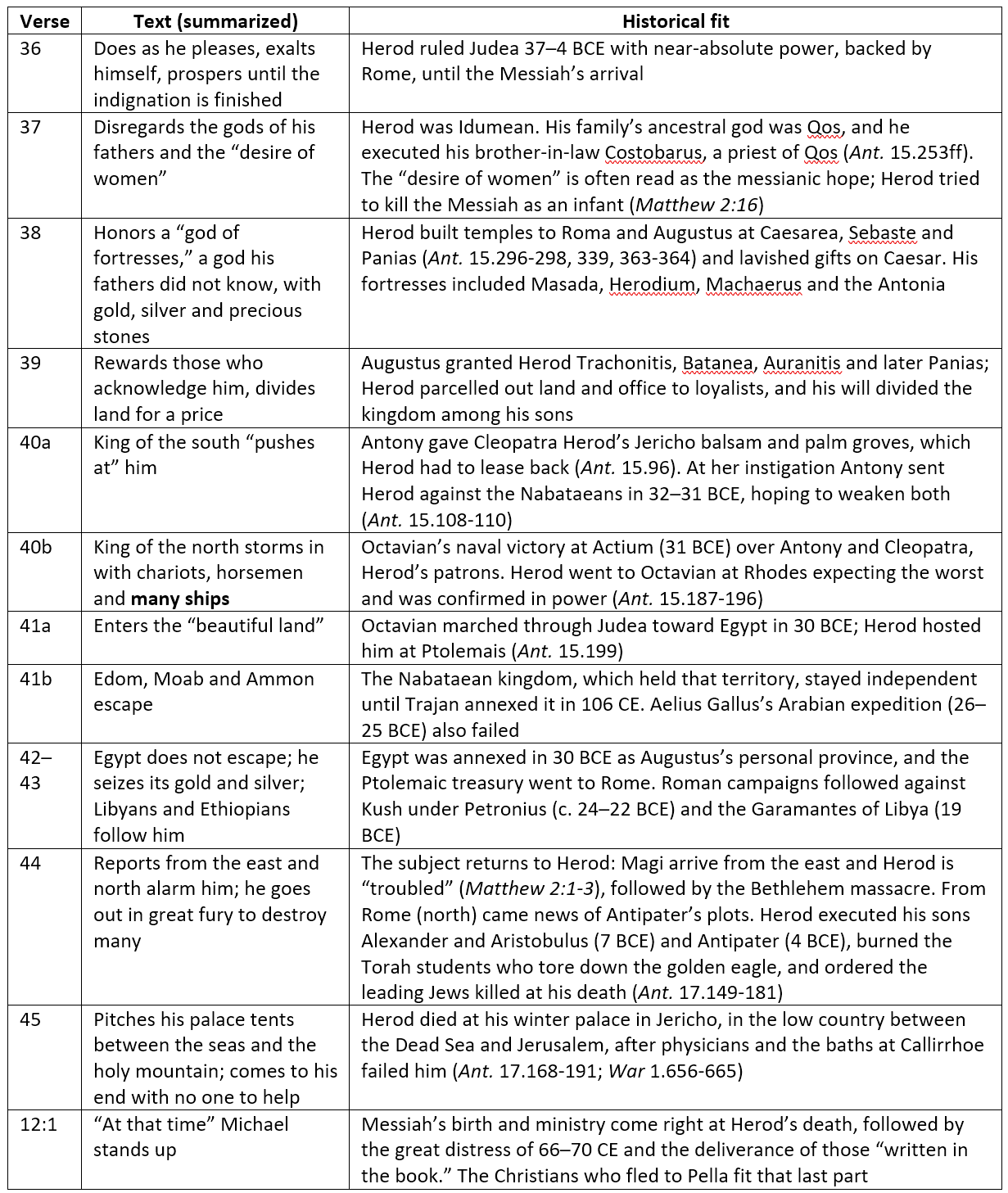
This reading also suits your understanding of Daniel 12:2: the awakening follows the ministry of Yeshua among Daniel’s people. The key to understanding that these verses apply to events of the first century is verse 40 which opens with “And at the time of the end.” The time of the end refers to the end of the Jewish system, a fact made clear by Peter when he referred to the prophecy of Joel in his great sermon at Pentecost in which 3,000 were baptized.
“But this is that having been spoken by the prophet Joel: And it will come to pass in the last days, God says, that I will pour out from My Spirit upon all flesh, and your⁺ sons and your daughters will prophesy, and your young men will see visions, and your old men will dream dreams. And even on My menservants and on My maidservants I will pour out from My Spirit in those days, and they will prophesy. And I will show wonders in the heaven above and signs on the earth below, blood and fire and vapor of smoke. The sun will be turned into darkness, and the moon into blood, before the coming Day of the Lord, great and glorious. And it will come to pass that everyone who shall call upon the name of the Lord will be saved.” (Acts 2:16-21 BLB)
What the Evidence Leaves Us
I am not claiming more than the evidence supports. Daniel 9 does not establish by itself that all of Scripture is divinely inspired. My argument is narrower than a general defense of the Book of Daniel.
First, Daniel demonstrably existed before Yeshua and before 70 CE. Second, Daniel 9 describes an anointed figure being cut off, followed by the destruction of Jerusalem and its sanctuary. Third, the standard Maccabean reconstruction encounters significant difficulties: the seventy-week arithmetic does not comfortably terminate at the events the interpretation requires, and Antiochus' desecration of the Temple is not the same event as its destruction. Fourth, the sequence in Daniel 9 corresponds strikingly with first-century history — Yeshua, his death, and the Roman destruction of Jerusalem and the Temple. Fifth, a Maccabean author could not have known those events by ordinary observation of what had already happened.
Would an independent observer without a dog in the fight assume that all we’ve just considered could be the result of mere coincidence? That is the question that each person must answer for themselves.